Leakage-Aware Benchmarking of Machine-Learning Models for Residential Appliance Energy Prediction Using a Public Smart-Home Dataset
DOI:
https://doi.org/10.37934/progee.32.2.3651Keywords:
Residential Energy Consumption, Appliance Energy Prediction, Machine Learning, Temporal Validation, Building Energy Efficiency, Green Building Analytics, Reproducible BenchmarkingAbstract
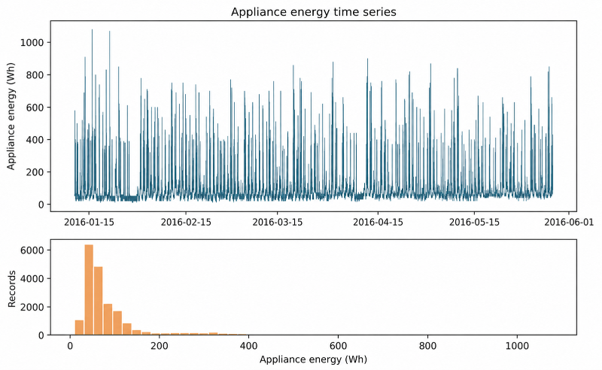
Accurate residential appliance energy prediction is useful for building energy monitoring, demand-response research, and green-building analytics, but performance estimates can be sensitive to validation design. This study presents a fully computational benchmark using the public UCI Appliances Energy Prediction dataset to compare common machine-learning models under random, chronological, and blocked temporal validation. The workflow validates and preprocesses 10-minute smart-home observations, engineers time features, evaluates linear and tree-based regressors, quantifies uncertainty with bootstrap confidence intervals, and uses permutation importance to interpret predictive associations. Under chronological testing, the best non-baseline model was Ridge regression, with MAE 52.54 Wh, RMSE 84.94 Wh, and R2 0.126. Its RMSE changed by -12.8% relative to the random split, illustrating that random validation can misrepresent performance in time-dependent energy data. Feature ablation and interpretability results indicate that all variables and variables including RH_2, RH_1, RH_3, hour_cos, T3 were most informative for this dataset. The contribution is a reproducible, leakage-aware energy analytics workflow, not a deployment or measured energy-saving study.