Sustainability and Innovation in Malaysia’s LNG Industry: A Systematic Literature Review
DOI:
https://doi.org/10.37934/progee.32.3.2242Keywords:
Liquefied Natural Gas (LNG), Malaysia, Energy Transition, Sustainability, InnovationAbstract
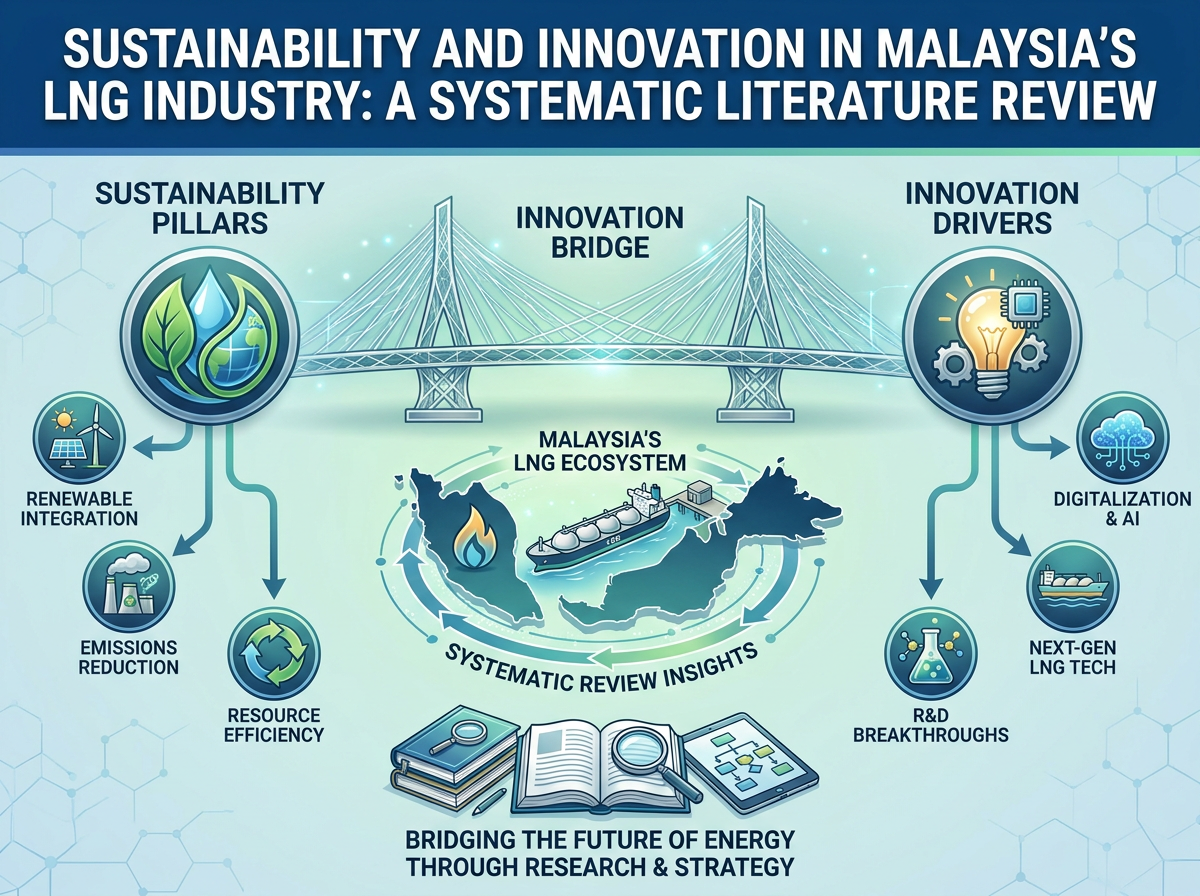
This study presents a systematic literature review of sustainability and innovation in Malaysia’s Liquefied Natural Gas (LNG) industry, conducted in accordance with the PRISMA 2020 framework. Boolean searches across five databases (Scopus, Web of Science, ScienceDirect, SpringerLink, and Google Scholar), with no date restriction, returned 923 records; title, abstract, and full-text screening against predefined criteria yielded 15 studies. Eligible studies addressed at least one of four dimensions: energy-economic linkages, green technological progress, structural dynamics of the LNG sector, and international benchmarking and technology transfer. The review finds incremental, mainly technical progress in cleaner technologies and energy efficiency. Because the evidence is drawn from a small, technically oriented corpus, these gains are indicative rather than conclusive; quantitative, LNG-specific sustainability metrics are scarce, so the policy implications are directional rather than prescriptive. The principal challenges are regulatory fragmentation (notably PETRONAS’s overlapping roles as regulator and operator), comparatively low RandD investment, and ageing infrastructure. Benchmarking against Qatar and Australia reveals capability gaps in carbon capture deployment. Working with companies across borders, especially those in Japan, creates opportunities to jointly develop carbon capture technologies. Key limitations are the small number of eligible studies (n = 15), the predominantly technical rather than socio-economic orientation of the corpus, and the exclusion of non-English publications.